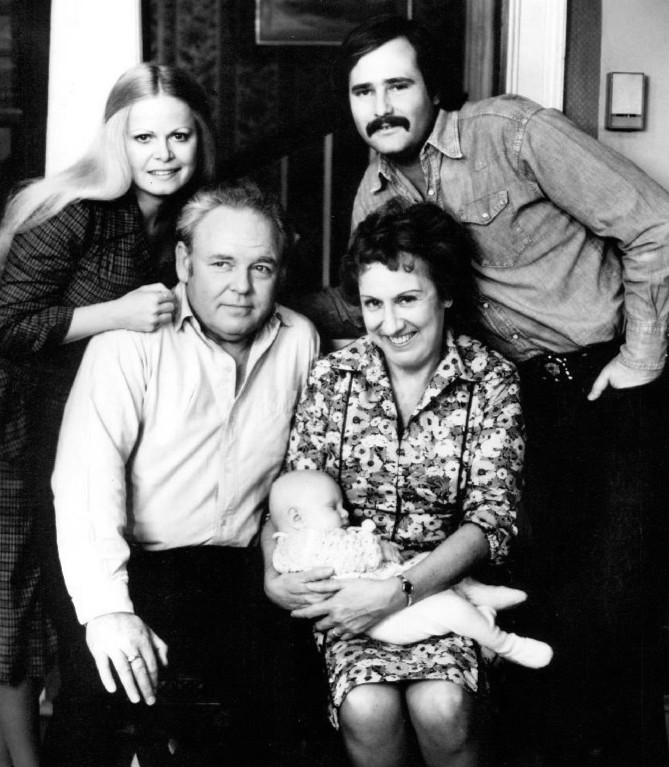
All in the Family: Partisan Disagreement and Electoral Mobilization in Intimate Networks—A Spillover Experiment

All in the Family cast 1976.JPG


Photo by CBS Television – eBay item  photo front  photo back, Public Domain, https://commons.wikimedia.org/w/index.php?curid=17261926


Authors Florian Foos and Eline A. de Rooij describe their forthcoming American Journal of Political Science article, titled “All in the Family: Partisan Disagreement and Electoral Mobilization in Intimate Networks – a Spillover Experiment,” in the following blog post.

[Archie’s daughter Gloria Bunker-Stivic:] “He’s not voting anyway, so three out of four votes from this house isn’t bad.”

[Archie Bunker:] “Well, she ain’t even gonna get that, little girl, because I just changed my mind. […] Edith and I are gonna vote. So that’s gonna cancel your two votes. So from this house you get zilch.”

(All In The Family, The Election Story, 1971, Season 2 Episode 6)

Voting is a social activity. Since the voting studies of the 1940s, political scientists have emphasized the importance of informal political discussions with family, friends and acquaintances for deciding whether to vote in an election, and which party to support. An important current debate centers on the question if political disagreement fuels mobilization or if people try to avoid potentially conflictual situations by abstaining from politics. In this paper we address this question by focusing on electoral mobilization in our most intimate network: the household. We ask whether households in which individuals support the same political party (“homogeneous”) are more or less conducive to electoral mobilization than households in which individuals support rival parties (“heterogeneous”).

Household members might refrain from discussing politics with those who support other parties in order to avoid conflict. Alternatively, in particular within households, people might more easily endure political disagreement, or might even enjoy discussing politics with non-like-minded others, experiencing a sense of competitiveness. If people are conflict avoiders, electoral mobilization between household members should be more pronounced in homogeneous partisan households; while in the latter, Archie Bunker scenario, mobilization should be equally, if not more pronounced in heterogeneous households.

One of the major challenges in answering this question is that we cannot be certain that it is political discussion that causes higher levels of turnout between homogenous household members, rather than individuals having self-selected into politically like-minded and highly engaged households. To address this causal inference challenge we used the unique features of a randomized spillover experiment that we conducted in the United Kingdom in 2012, combined with a detailed database on voters’ party preferences. We used a voter list to randomly allocate one registered voter per household to one of three groups. Labour Party volunteers attempted to contact subjects in the first and the second group by phone encouraging them to vote in an upcoming election. The message to the second group was far more (Labour) partisan in tone than the message to the first group and hence increased the potential for partisan disagreement between household members. Subjects in the third (control) group received no phone call. By subsequently examining whether the turnout levels of the subjects’ household members increased after the election, we can gauge whether our mobilization messages were more likely to “spill over” through political discussion within homogeneous or heterogeneous partisan households.


Figure 1. The spillover effects of targeting subjects with a campaign message on the turnout of their household members (a – top); and of receiving high versus low intensity partisan messages on the turnout of their household members (b- bottom)

All in the Family: Partisan Disagreement and Electoral Mobilization in Intimate Networks—A Spillover Experiment (Figure 1a)

All in the Family: Partisan Disagreement and Electoral Mobilization in Intimate Networks—A Spillover Experiment (Figure 1b)

Note: 95% confidence intervals. Based on Figures 3a and 5a in the article.


We find that turnout rates are, if anything, higher among the household members of subjects in heterogeneous households than among those in homogeneous households (or in households without a partisan attachment) as a result of campaign messages generally (Figure 1a). This suggests that members in households that support different parties do not refrain from political discussions in order to avoid conflict. Figure 1b shows that turnout rates are larger still among non-experimental members of heterogeneous households when the partisan tone of the message –and thus the likelihood of discussion– is increased.

Political discussion within personal networks is widely believed to benefit the functioning of democracy by raising political interest and aiding political opinion formation, and ultimately boosting turnout. An important question touches on what kinds of networks are most beneficial. We show that within households the electoral mobilizing function of discussion is certainly not restricted to those in which individuals support the same political parties. It remains an open question whether disagreeing household members mobilize as a result of having been persuaded, or in order to cancel out the other’s vote.
Can Political Inequalities be Educated Away?

The forthcoming article ”Can Political Inequalities Be Educated Away? Evidence from a Large-Scale Reform” by Karl-Oskar Lindgren, Sven Oskarsson, and Christopher T. Dawes is summarized here:Can Political Inequalities Be Educated Away? Evidence from a Large-Scale Reform

Equal access to public office for all individuals is on the UN’s list of basic human rights. Yet, a brief look at the composition of the legislatures around the world shows that this formal right does not necessarily translate into equal political representation for all segments of society. On the contrary, research on legislative recruitment consistently finds that opportunities to hold political office are highly unevenly distributed in all societies.

Whether the social bias of elected assemblies constitutes a problem is an issue that has been debated since the inception of representative government. All sides agree that no one should be entitled to public office by accident of birth. Consequently, the fact that an individual’s chances of having a career in politics, at least partly, depends on the status of his or her parents has been a source of concern for observers across the political spectrum.

Over the years, many suggestions have been made on how to reduce the importance of family background in political recruitment. One much discussed solution is that of improved educational opportunities for the masses. Thomas Jefferson was an early proponent of this view in arguing for increased educational attainment as a way to replace what he referred to as an artificial aristocracy based on wealth and fortune with a natural aristocracy based on talent and virtue. Since Jeffersonian times, the idea that equality of educational opportunity is a necessary condition for political equality has gained considerable currency in liberal democratic thought. Yet critics of this view argue that this is a vain hope, as privileged social groups will invest in higher education in order to maintain their relative advantage.

In our study we examine the veracity of these positions. More precisely, we analyze how a large comprehensive school reform launched in Sweden in the 1950s, which lengthened compulsory schooling and postponed tracking, affected the likelihood of individuals with different family background to run for public office. The data used in the analysis pertain to the entire Swedish population born between 1943 and 1955 and contains complete records of all individuals that ran for public office in each of the six general elections held between 1991 and 2010.

Overall, we find strong support for the view that educational expansion can further political equality. According to our analysis, increased education reduced the effect of family background on the likelihood of seeking public office by as much as 40 percent. These findings thus support the idea embraced by democratic thinkers from Jefferson and onward that an expansion of mass education can help mitigate the political underrepresentation of individuals from lower rungs of the socioeconomic ladder.

About the Authors: Karl-Oskar Lindgren is a Senior Lecturer in the Department of Government at Uppsala University (Sweden), Sven Oskarsson is a Senior Lecturer in the Department of Government at Uppsala University (Sweden), and Christopher T. Dawes is Assistant Professor in the Wilf Famly Department of Politics at New York University. Their article ”Can Political Inequalities Be Educated Away? Evidence from a Large-Scale Reform” will be published in a forthcoming issue of the American Journal of Political Science and is currently available for Early View.

College Socialization and the Economic Views of Affluent Americans

The article “College Socialization and the Economic Views of Affluent Americans” by Tali Mendelberg, Katherine McCabe, and Adam Thal, summarized by the authors here, is currently available for Early View prior to publication in a forthcoming issue of the American Journal of Political Science.

AJPS_AuthorSummary_EarlyViewAffluent Americans support more conservative economic policies than the non-affluent, and these views matter, because they influence public policy disproportionately. Yet little is known about the emergence of these consequential views. Our research suggests that the affluent’s support for economic conservative policies is partly socially learned. In this study, we develop, test and find support for a theory of class cultural norms: affluent individuals emerge with more conservative preferences when they are immersed in social environments that activate affluent interests. Affluent conservative preferences are partly traceable to socialization that occurs on predominately affluent college campuses.

Previous research on college characteristics has not attended to the effects of concentrated affluence on campus or economically conservative social norms. Consequently, it concluded that college liberalizes. We find that college can also conservatize.

In the current era of high income inequality, college attendance is heavily conditional on high parental income, leading many campuses to be populated mostly by affluent students. We argue that affluent campuses produce an affluent class culture. When this culture combines with a cohort norm of financial gain, it socializes affluent students to conceive of their class interests in a way that favors pro-wealth views. Some of the effect is due to more economically conservative cohort norms. Non-affluent students are not affected by gain-oriented campus affluence, though they are as affected as affluent students by cohort economic conservatism.

Our study advances these questions with some methodological innovation. We use a large two-wave panel dataset with freshman- and senior-year re-interviews of 29,113 affluent college students from 359 schools. Conditional on the student’s view in freshman year, affluent students attending affluent campuses emerge from college with views that are significantly more conservative than affluent students at non-affluent campuses. This effect is particularly strong on campuses where most students indicate they are attending college for financial gain, and among the students who are most embedded in the social environment—who are most likely to absorb the social norms. The collective economic opinion of the student’s cohort also affects individual preferences. The results hold using multiple strategies to achieve better causal inference. Along with controlling on faculty views, curriculum, and other confounds, these include matching, a natural experiment, and examining students who applied to but were rejected by affluent or non-affluent schools, which eliminates selection into school affluence.

These findings reveal larger political and social consequences of rising income inequality. Inequality in access to colleges and universities begets student bodies lacking economic diversity, creating a concentration of affluent students and affluent norms on campus. These norms, in turn, activate affluent students’ conservative class interests and shape their economic views. More generally, these findings imply an important role for institutionalized social forces in political socialization. The consequential views that affect policy are partly shaped by the social environments that adults inhabit in the impressionable years of young adulthood.


MNCs, Rents, and Corruption: Evidence from China

Below Boliang Zhu summaries the forthcoming American Journal of Political Science article titled “MNCs, Rents, and Corruption: Evidence from China”.

Outdoor display stock market data

 How does multinational corporation (MNC) activity affect corruption in developing countries? It is commonly believed that foreign investment undertaken by MNCs is beneficial to host countries through bringing in capital and technology, creating jobs, and boosting exports. Furthermore, the entry and presence of MNCs may increase market competition and help to diffuse norms and values such as economic neoliberalism, rule of law, and property rights protection. Therefore, MNC activity is expected to reduce corruption and improve domestic governance.

However, there are ample anecdotes that MNCs engage in unethical activities, such as bribery, in developing countries. Prominent MNCs, such as Alcatel-Lucent, Daimler, Pfizer, Siemens, and Wal-Mart, all have been found to bribe government officials to secure contracts and expand business in developing countries. It seems that existing accounts oversimplify the impact of MNCs on corruption. In my forthcoming AJPS article, I investigate the relationship between MNC activity and corruption in developing countries. I argue that MNC activity can lead to high corruption by increasing market concentration and thus contributing to rent creation. MNCs can accelerate market concentration in two ways: first, MNCs with advanced technology, sophisticated managerial and marketing skills, and easy access to capital are able to enter markets with high entry barriers which often deter indigenous firms in developing countries. After entry, multinationals may further enhance entry barriers for new entrants in order to pursue monopolistic or oligopolistic market positions; second, more productive MNCs can take over local firms or drive the least efficient ones out of business, thereby decreasing market competition. A concentrated market results in high rents, which, on the one hand, make firms more able to afford the costs of bribery, and on the other hand, increase government officials’ incentives of demanding bribes. Therefore, more MNC activity will lead to higher corruption levels in developing countries.

To test this argument, I conduct a case study on China—the largest developing country, and draw from data of annual procuratorial reports and of public opinion and business surveys to measure corruption levels of China’s provinces. I find that provinces with more MNC activity are strongly associated with more corruption, e.g., more recovered corrupt funds per filed case or per capita, more senior cadres involved, a higher level of perceived corruption by citizens, a higher frequency of citizens witnessing corruption, and a higher firm expenditure on entertainment and travel costs—an accounting category commonly used to reimburse illegitimate expenses in China. Furthermore, mediation analysis indicates that MNC activity contributes to high corruption levels partially through increasing market concentration.

The findings in the paper have important policy implications. It is true that foreign investment undertaken by MNCs is beneficial for developing countries’ economic growth. But, MNC activity can also generate some unintended consequences, such as corruption or bad governance more generally, posing challenges for sustainable development. While actively attracting foreign investment, governments in developing countries should devote efforts to establishing effective antitrust laws and enforcing government regulations to ensure fair competition.

About the Author:  Boliang Zhu is Assistant Professor of Political Science at the Pennsylvania State University. His article “MNCs, Rents, and Corruption: Evidence from China is currently available for Early View prior to publication in a forthcoming issue of the American Journal of Political Science.

The Politics of Health Care and the Psychology of Issue Differences

The article “The Deservingness Heuristic and the Politics of Health Care” (AJPS 61:1 –  January 2017) by Carsten Jensen and Michael Bang Petersen is summarized here:

Political scientists have always known it: issues differ. Position issues are issues that spur political conflict and where citizens hold opposing views on what constitute the right policies. Valence issues, in contrast, stand out because everyone agrees about their importance and the basic gist of the needed policies.

One pair of issues that differ sharply along the position-valence dimension is unemployment protection and health care. Both issues are at the core of the welfare state, the policies affect the lives of millions and both issues are concerned with risks that are heavily influenced by socio-economic status: people with low socio-economic status are much more likely to become unemployed and ill. Unemployment is a clear-cut position issue: people are divided on whether the unemployed deserves government help. Health care is, in contrast, a valence issue and people across socio-economic strata and across countries stand united in a demand for higher levels of public spending on health care. While this might seem surprising for American political scientists, given the high levels of political conflict associated with not least Obamacare, the data in Figure 1 paints a crystal-clear picture: across the Globe, everyone wants more health care. The only thing that is debated is the means to that end.

AJPS_BangPeterson

Note: Figure 1 is reproduced from Jensen & Petersen (2016). The figure combines data from the 2008 European Social Survey (ESS, Panel A) with data from the 2006 International Social Survey Programme (ISSP, Panel B) and covers 105,393 subjects from 41 countries. Dark grey bars represent percentage of a population strongly supporting public health care; light grey bars represent the percentage of a population strongly supporting unemployment protection.


The question that we wanted to answer is: Why? How do two so similar issues emerge as so different? More to the point: Why is there such unanimous support for health care spending?

The traditional approach to understanding issue differences in political science is to look at how elite discussions constraint people’s thinking about issues, what Phillip Converse termed social sources of constraint. We have instead turned toward another source of constraint: psychological ones and, in particular, the deeper processes of biological evolution that have shaped these constraints.

In a broad, historical perspective, unemployment is a novel issue which first emerged during the industrial revolution. In contrast, as is evidenced by the existence of some form of immune systems in all organisms, the need to defend against infections and injuries is evolutionarily ancient. Importantly, for humans at least, parts of the defense against the consequences of health problems are social and take the form of care from others. Archaeologists have thus found suggestive evidence of health care in the Pleistocene fossil record and anthropologists have observed both the spread and importance of health care practices in forager societies.

Evolutionary biologists and anthropologists have accordingly argued that health care is an evolved feature of human life history and that our psychology has been designed to respond to health problems with a motivation to provide care. One key reason for the evolution of health care is that evolutionarily recurrent health problems were very different from the health problems of today. Today, the major causes of health problems are lifestyle related and highly predicted by socio-economic status. According to anthropological research, the major causes of ancestral health problems were, in contrast, accidental infections and injuries – something that could and did affect everyone.

We argue that when people think about modern health care, their minds are constrained by assumptions that were ancestrally valid, that sick people are unfortunate and deserving of care. When thinking about the recent issue of unemployment, in contrast, psychological constraints are fewer and political disagreements more easily occur. As consequence, health care itself emerges as a valence issue and unemployment as a position issue.

We have tested a number of observable implications of this argument with regards to differences between opinions about health care and unemployment, respectively. Using so-called implicit association tests, we show that already at the level of preconscious, implicit processing people are unified in a view of sick individuals as victims of circumstances beyond their control. This is not the case for unemployed individuals. We have shown repeatedly that these implicit associations constrain health care attitudes even in the face of countervailing factors. When people are exposed to explicit arguments suggesting that sick individuals are themselves at fault for their plight, they still hold on to their belief of deservingness. Even if people’s self-interest should prompt them to reduce support for public health care, they continue to view sick individuals as deserving. In line with the argument that fewer psychological constraints fixate attitudes and beliefs about unemployed people, people are, in contrast, much more moved by self-interest and available information on this issue. In a final cross-cultural test, we show that this difference in the degree of psychological constraint cause attitudes towards the unemployed to be highly correlated with political ideology in three, otherwise highly different countries: United States, Japan and Denmark. Attitudes towards the sick, in contrast, are uncorrelated with political ideology. Everyone across these countries and across the political spectrum believe that sick people are deserving.

In this way, by knowing the evolutionary trajectories of different political issues and by analyzing the psychological constraints that these trajectories have selected for, we as political scientists can build testable theories of the psychologies of issue differences.

About the Authors: Carsten Jensen and Michael Bang Petersen are Professors in the Department of Political Science at Aarhus University. Their forthcoming article “The Deservingness Heuristic and the Politics of Health Care” was published in volume 61, issue 1 of the American Journal of Political Science.


Dynamic Policymaking with Decay

AJPS_AuthorSummary_EarlyViewSteven Callander and Gregory Martin describe research from their forthcoming American Journal of Political Science article, titled “Dynamic Policymaking with Decay”:

Real politics takes place in a world that is constantly changing. As time passes, the population grows, new technologies are invented, and the skills, demographics, and norms of the populace evolve. Policies that were well-designed and carefully adapted to conditions in the past may be ill-suited to conditions today: to give but one example, consider the catastrophic failure of securities regulations created in an era of stocks and bonds to effectively monitor the market for novel mortgage backed securities and credit default swaps prior to the 2008 financial crisis.

We explore the consequences of this kind of change over time – which we term policy decay – for the practice of politics. Our results show that decay generates a force for legislative action, a force that can be exploited by the current holder of agenda-setting power. We show how a changing world drives the dynamic path of legislation, undermining the conventional wisdom of legislative gridlock. Decay reveals a novel conception of policy expertise, and, ultimately, provides a foundational logic to the design of bureaucracy.

 About the Authors: Steven Callander is a Professor of Political Economy, Stanford Graduate School of Business and Gregory J. Martin is an Assistant Professor of Political Science at Emory University. Their article “Dynamic Policymaking with Decay is currently available for Early View prior to publication in a forthcoming issue of the American Journal of Political Science.

Immigration Attitudes and Support for the Welfare State in the American Mass Public

Authors James C. Garand, Ping Xu, and Belinda C. Davis describe their American Journal of Political Science article from 61:1 – January 2017 titled “Immigration Attitudes and Support for the Welfare State in the American Mass Public,” in the following blog post:

The increase in the immigrant population in the United States over the past four decades has drawn considerable attention from both scholars and political observers. Scholars have considered the economic, political, and social implications of the influx of immigrants, and politicians and the mass public are embroiled in debates about the degree to which expanded immigration has had a positive or negative effect on American society. In particular, there is disagreement about whether immigrants are net detractors by drawing a disproportionate level of resources from the American welfare state.

It is in this context that we consider in this paper the effects of Americans’ attitudes toward immigration on their support for the welfare state. In previous research scholars have explored the relationship between racial attitudes and welfare attitudes, and these studies have shown that how Americans think about race is related to how they think about welfare programs (Gilens, 2000). Simply, Americans who have positive views toward black Americans and who see blacks as conscientious and hard-working are significantly more likely to support welfare programs than those who have more negative views toward black Americans.

In this paper we use data from the Cumulative American National Election Study (CANES) from 1992 to 2012 to explore the linkage between individuals’ immigration attitudes and their attitudes toward welfare. We measure immigration attitudes in three ways: (1) affect toward illegal immigrants, based on a feeling thermometer ranging from 0 (negative) to 100 (positive); (2) support for immigration, measured as a three-point scale ranging from -1 (respondent supports decreased immigration) to +1 (respondent supports increased immigration); (3) a “pro-immigration” scale, based on a factor analysis of the first two items. We measure welfare attitudes using two survey items: (1) affect toward welfare recipients, ranging from 0 (negative) to 100 (positive); and (2) support for welfare spending, measured as a three-point scale ranging from -1 (respondent supports decreases in welfare spending) to +1 (respondent supports increases in welfare spending). We estimate a series of regression and ordered logit models using these variables, and we include in our models controls for affect toward blacks, affect toward the poor, partisan identification, liberal-conservative ideology, gender, racial variables, age, education, family income, church attendance, and fixed effects for state and year.

We find strong support for our hypothesis that immigration attitudes are positively related to welfare attitudes. Simply, in all of our models individuals who think highly of illegal immigrants and/or who support increases in immigration are strongly and significantly more favorable in their assessments of welfare recipients and more supportive of increases in welfare spending. These results stand even in the face of statistical controls for other variables thought to have an effect on welfare attitudes. The magnitude of these effects is quite high. To illustrate, in Figure 2 from the paper we show the effects of the pro-immigration scale on the predicted probabilities that individuals support increased, decreased, or the same level of welfare spending. As one can see, increases in pro-immigration attitudes result in a substantial decrease in the probability that individuals support decreases in welfare spending, from p = 0.532 for the lowest value on the pro-immigration scale to p = 0.229 for the highest value. On the other hand, increases in pro-immigration attitudes result in discernible increases in both the probability that individuals support increases in welfare spending or keeping welfare spending the same. Clearly, how Americans think about immigration has a strong effect on attitudes toward welfare spending.

Figure 2. Scatterplot of relationship between pro-immigration attitudes and support for greater welfare spending, selected years (1992-2012), Cumulative American National Election Study

garand

What is particularly noteworthy about our findings is that the magnitude of immigration attitudes effect is the second largest in our model, only behind the magnitude of the effect of attitudes toward the poor. In other words, how Americans think about immigration is the second strongest predictor of welfare attitudes, even greater than the effects of attitudes toward blacks, partisan identification, liberal-conservative ideology, and family income, among others. This suggests the “immigrationalization” of welfare attitudes during a time period that has seen a substantial increase in both the number of immigrants and the share of immigrants participating in some welfare state programs.

Finally, our finding that Americans’ immigration attitudes shape their welfare attitudes withstands a number of robustness tests. We consider the possibility that the relationship between immigration attitudes and welfare attitudes is endogenous, but our 2SLS models continue to show a strong effect of immigration attitudes in shaping how Americans think about welfare. Further, we estimate our models separately for white respondents only, for respondents who are from immigrant and non-immigrant families, and for the periods before and after welfare reform efforts in the mid-1990s. In each case the coefficients for immigration attitudes are of high magnitude and statistically significant, suggesting that the relationship between immigration attitudes and welfare attitudes is robust across different individual attributes and contexts.

The bottom line is that how Americans think about immigration is a powerful predictor of Americans’ welfare attitudes. Based on our findings, we contend that the immigration wave and resulting demographic change that has occurred in the past four decades has shifted America’s welfare state from being “racialized” (Gilens 2000) to being more “immigrationalized.”

Reference:

Gilens, Martin. 2000. Why Americans Hate Welfare: Race, Media, and the Politics of Antipoverty Policy. Chicago: University of Chicago Press.

Conspiracy Endorsement as Motivated Reasoning: The Moderating Roles of Political Knowledge and Trust

The article “Conspiracy Endorsement as Motivated Reasoning: The Moderating Roles of Political Knowledge and Trust” (AJPS 60:4 – October 2016) by Joanne M. Miller, Kyle L. Saunders, and Christina E. Farhart is summarized by the authors here:

Contrary to the popular conception that conspiracy theorists are a small group of tinfoil hat-wearing men who spend most of their time in bunkers, conspiracy theories are not solely the domain of extremists and paranoids. They cut across demographics and political identities, and are pervasive across the globe. Conspiracy beliefs can also affect policy attitudes, social behaviors, and even medical choices. Further, just the presence of these theories in the public zeitgeist can distract political elites from attending to more pressing public policy concerns. For example, President Bush had to repeatedly respond to accusations that he and Dick Cheney staged the 9/11 attacks, and President Obama had to hold a press conference for the sole purpose of releasing his long-form birth certificate.

Given the potential political and social significance of conspiracy beliefs, a substantial and growing body of work examines the individual-level correlates of conspiracy endorsement. Our article builds on this extant literature to posit that conspiracy endorsement is a motivated process that serves both ideological and psychological needs. In doing so, we develop a theory that argues that the tendency to endorse a conspiracy theory is highest among people who 1) have a particular ideological worldview to which the conspiracy theory can be linked (i.e. liberals or conservatives), 2) have the motivation to protect that worldview and the ability to see how endorsing the conspiracy would serve that purpose (i.e., political sophisticates), and 3) believe that the world is the type of place in which secretive, malevolent actions are not only possible, but also probable (i.e., people low in trust). In other words, knowledge should exacerbate ideologically-motivated conspiracy endorsement and trust should mitigate it.

To test the hypotheses derived from our theory, we administered an original survey via MTurk in 2013 and replicated our findings using the 2012 ANES. We assessed belief in “conservative” conspiracy theories (ones that impugn liberals/Democrats) and “liberal” conspiracy theories (ones that impugn conservatives/Republicans), as well as ideology, political knowledge, and generalized trust.

Consistent with the theory of motivated reasoning, conservatives are more likely to endorse the conspiracy theories that impugn their political rivals, and vice versa. Our results also confirm our hypothesis that political knowledge exacerbates ideologically-motivated conspiracy endorsement whereas trust simultaneously mitigates it. Interestingly, however, this hypothesis is only confirmed for conservatives (i.e. high knowledge-low trust conservatives are the highest endorsers of conservative conspiracy theories). For liberals, trust is negatively associated with endorsement of liberal conspiracy theories, but knowledge is either not associated with or independently negatively associated with endorsement of liberal conspiracy theories.

This ideological asymmetry—a result that was consistent across both datasets—was unexpected, but is consistent with the notion that conspiracy endorsement, and science denial more generally, is a more attractive worldview-bolstering strategy for conservatives than liberals. It is also consistent with an alternative explanation–given that both surveys were conducted during a Democratic presidential administration, conservatives may have been situationally induced to be more motivated to bolster their worldviews (as would have liberals if the political situation had been reversed). We consider these and other alternative explanations for the asymmetry in the article.

Our results have broader implications for an increasingly polarized political discourse. As we well know, political sophisticates tend to be among the most active citizens in the United States; our findings therefore highlight a normatively displeasing notion for those who wish to view democracy through even the most rose-colored of lenses. In today’s political environment, elites (however defined) can cast outrageous aspersions against their nemeses, and can count on at least a segment of their knowledgeable (and less trusting) base to endorse (and possibly spread) what is essentially misinformation. Not only does elite polarization increase motivated reasoning within the mass public, but it is precisely this kind of motivated reasoning (endorsing ideologically-consistent conspiracy theories) that would also exacerbate polarization and rancor among elites and active partisans.

The Company You Keep: How Citizens Infer Party Positions on European Integration from Governing Coalition Arrangements

The forthcoming article “The Company You Keep: How Citizens Infer Party Positions on European Integration from Governing Coalition Arrangements” by James AdamsLawrence Ezrow, and Christopher Wlezien is summarized by the authors here:

Democratic accountability requires citizens to inform themselves about political parties’ issue positions.  Citizens may employ heuristic “shortcuts” to update their perceptions of parties’ positions, for a number of reasons, for example because collecting detailed political information is costly or because the political landscape is uncertain.

Our paper examines how citizens infer parties’ policies on European integration based on the set of parties participating in the coalition government.  Recent studies document that voters infer that coalition partners’ Left-Right policy positions converge when these parties enter into a joint governing coalition.  We show that citizens apply a similar coalition-based heuristic to infer parties’ positions along the European integration dimension.  Specifically, citizens infer that, over time, junior coalition partners shift their European integration policies in the same direction as the Prime Ministerial (PM) party’s perceived shift on this issue.  Figure 1 depicts these effects.  It displays how the PM party’s perceived shift on European integration correlates strongly with the perceived policy shifts of its junior coalition partners, but not with opposition parties’ perceived shifts.  (Junior coalition partners are displayed as a dotted line in the figure and opposition parties as a solid line, with shaded confidence intervals).  These patterns suggest that voters employ a coalition-based heuristic to update their perceptions of party policy positions on European integration.

Figure 1. Predicted effects of Perceived PM Party Shifts on the
Perceived Shifts of Junior Coalition Partners and Opposition Parties

Notes. The figure charts the predicted effects of the Prime Ministerial (PM) party’s perceived shift on the perceived shifts of junior coalition partners (the solid line) and on opposition parties (the dotted line), based on model estimates presented in the paper. The shaded regions are set so that the probability is under .05 that the predicted values overlap.

Notes. The figure charts the predicted effects of the Prime Ministerial (PM) party’s perceived shift on the perceived shifts of junior coalition partners (the solid line) and on opposition parties (the dotted line), based on model estimates presented in the paper. The shaded regions are set so that the probability is under .05 that the predicted values overlap.

Furthermore, we show that citizens’ coalition-based inferences on European integration conflict with alternative measures of party positions; in particular, neither political experts’ perceptions of party positions nor the codings of parties’ election manifestos support voters’ inference that junior coalition partners adjust their own positions on Europe in response to the PM party’s policy shift.  This disconnect implies that citizens might be cautious about applying the coalition-based heuristic to the European integration dimension.  We also show that citizens’ perceptions of party positions on Europe matter, in that citizens react to parties’ perceived shifts by updating their own policy views and/or their party support, i.e., these perceived party policy shifts drive partisan sorting in the electorate.

Our findings have straightforward implications for mass-elite policy linkages and for parties’ election strategies.  For example, the European issue is relevant to the strategic calculations of radical right parties, whose electoral appeal is tied to their anti-EU stances, including the National Front in France, Golden Dawn in Greece, the British National Party, and the Dutch PVV.  To the extent that these parties’ images as staunch anti-EU parties are compromised when they govern in coalition with a more moderate Prime Ministerial party, these radical right parties may have electoral incentives to withhold this support from the government.

The Voters’ Curses: Why we need goldilocks voters

The forthcoming article “The Voters’ Curses: Why we need goldilocks voters” by Carlo Prato and Stephane Wolton is summarized by the authors here:

It is commonly accepted that a more engaged electorate would improve the performance of the democratic system. Indeed, voters who care significantly about politics should possess better information and consequently, encourage politicians to choose policies more in line with their interest. In `The Voters’ Curses: Why We Need Goldilocks Voters’, we find that this intuition is correct as long as politicians’ behavior is constant in voters’ level of political engagement. However, we also demonstrate that this logic is fundamentally flawed because politicians strategically respond to changes in voters’ political engagement. As a result of politicians’ behavior, high interest in politics can be associated with a poor performance of the democratic process.

We analyze a game-theoretic model of elections which distinguish between voters’ interest in politics (how much they care about politics) and attention to politics (how much they listen to candidates). Building on Downs’ (1957) notion of rational ignorance, we suppose that voters need to pay costly attention to the electoral campaign to learn candidates’ platforms.

In line with existing theory, we find that when voters’ interest is low, candidates have little incentive to choose policies beneficial to voters and the democratic system performs poorly. We term this phenomenon `the curse of the uninterested voter’. Our theory also predicts a low performance of the democratic system when voters’ interest is very high. High interest can create the wrong incentives for the wrong kind of candidates: Candidates would propose the voters’ preferred policy even when they do not have the necessary competence to successfully implement it. We term this phenomenon `the curse of the interested voter.’ Like Goldilocks who “likes her porridge not too cold, not too hot, likes it just right,” the best policy outcomes occur when voters care about politics not too little and not too much.

A direct implication of our results is that policy intervention meant to decrease voters’ cost of acquiring political information (e.g., subsidy for public service broadcasting) can have negative unintended consequences. A lower cost of attention would increase the electoral reward from proposing voters’ preferred policy augmenting the risk that incompetent candidates promise change despite being unable to successfully carry it out.

A slightly more subtle implication regards the relationship between interest and attention. Previous empirical studies have conflated these two notions of engagement; our paper shows the importance of distinguishing between them. When voters’ interest is high, incompetent candidates imitate competent ones by proposing the same type of policies. Voters become skeptical about learning candidates’ platforms since they do not know whether they will benefit from the policy announced by the candidate. Consequently, they pay little attention to the campaign despite a high interest in politics.

Our paper, therefore, shows that the well-documented fact that voters’ political knowledge is limited is not necessarily the result of voters’ caring little about politics, it can also be caused by candidates’ strategic behavior.


The American Journal of Political Science (AJPS) is the flagship journal of the Midwest Political Science Association and is published by Wiley.